Best AI Chatbot for Facebook Pages in Indonesia (2026)
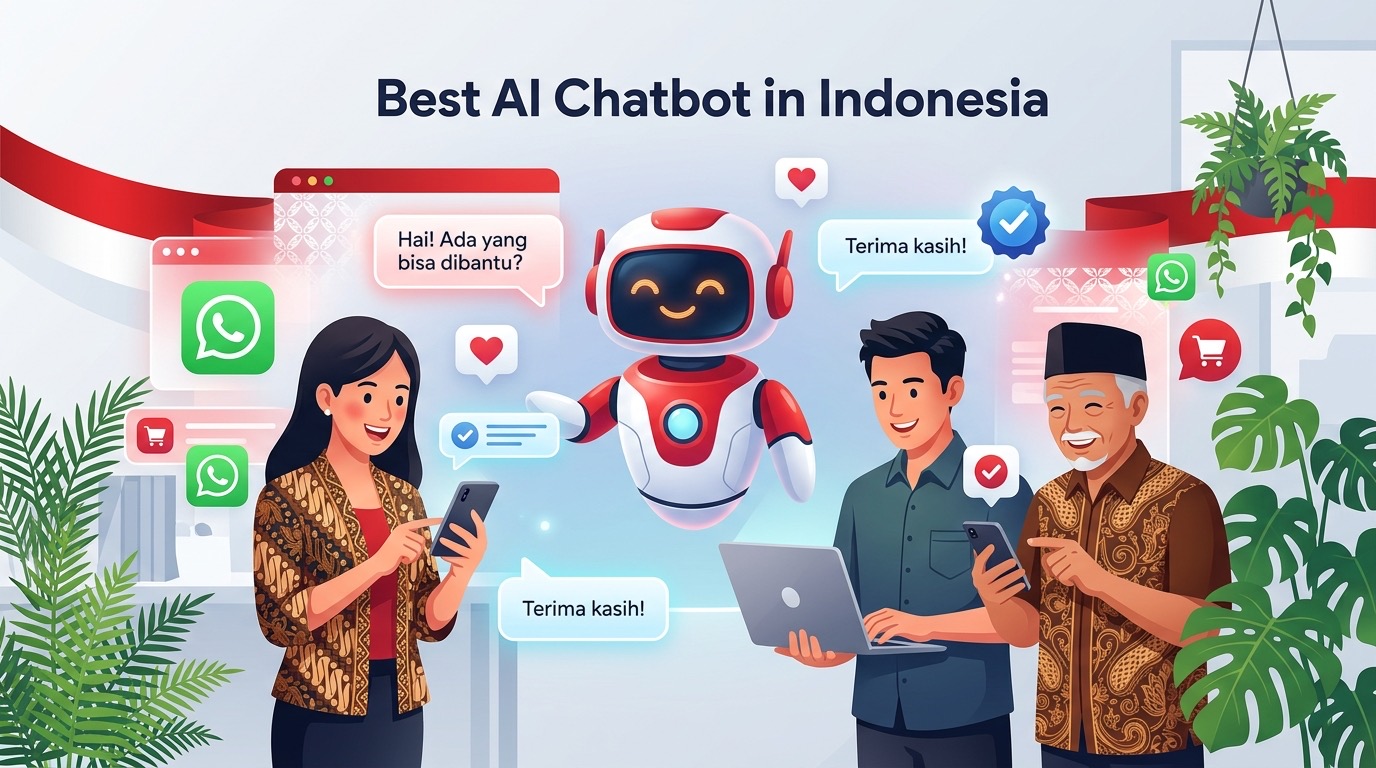
The digital landscape of Indonesia has undergone a seismic shift over the past decade, but one constant remains: the absolute dominance of Facebook as a primary channel for social commerce (F-commerce). As we navigate through 2026, the Indonesian e-commerce market is no longer just about traditional marketplaces like Tokopedia or Shopee; it is heavily decentralized, thriving on social networks where conversations drive conversions. Indonesian consumers demand a highly personalized, conversational, and instant shopping experience. They do not just want to click "Buy Now" on a static page; they want to chat, ask about product details, negotiate, and feel a sense of human-like connection before making a transfer.
In this hyper-competitive environment, managing a Facebook Page with thousands of daily inquiries is impossible for a purely human customer service team. The volume is too high, the expectations for instant replies (even at 2 AM) are too strict, and the cost of maintaining a 24/7 human army is prohibitive for most small-to-medium businesses (SMBs) and even large enterprises. This is where Artificial Intelligence (AI) chatbots step in. However, the chatbots of 2026 are not the rigid, keyword-based decision trees of 2018. Today's AI chatbots understand context, speak fluent Bahasa Indonesia (including regional slang and mixed languages like Bahasa Gaul), read directly from live inventory, and can process end-to-end transactions without ever requiring the customer to leave Facebook Messenger.
Finding the best AI chatbot for your Facebook Page in Indonesia requires looking past global popularity and focusing on hyper-local capabilities. A bot that works brilliantly in the US might fail spectacularly in Jakarta if it cannot handle QRIS payments, integrate with local couriers like JNE or SiCepat, or understand the nuances of Indonesian conversational commerce.
In this massive, 4,000+ word deep dive, we will explore the state of F-commerce in Indonesia in 2026, dissect the essential features your chatbot must possess, critically review the top players in the market (both local and global), and definitively prove why Sells Pilot has emerged as the superior, unrivaled choice for serious F-commerce merchants in the archipelago.
2. The State of F-Commerce in Indonesia in 2026
To understand why you need a specific type of AI chatbot, you first need to understand the unique ecosystem of Indonesian F-commerce. Indonesia, with its population of over 280 million people, boasts one of the highest internet penetration rates in Southeast Asia. More importantly, Indonesians are inherently social shoppers.
The Shift from Marketplaces to Conversational Commerce
While traditional e-commerce giants still hold significant market share, there has been a massive resurgence in direct-to-consumer (DTC) sales via social media. The reasons are multifold:
- Trust Building: In a high-fraud environment, consumers prefer talking to a "representative" of the store before wiring money. Chatting provides reassurance.
- Customization and Consultation: Fashion, beauty, and electronics often require consultation. "Sis, does this shade of lipstick suit olive skin?" or "Gan, is this RAM compatible with my motherboard?" are standard pre-purchase questions.
- Frictionless Discovery-to-Purchase: When a user sees an ad on Facebook, the lowest friction path is to click "Send Message" and buy right there. Forcing them to click a link, wait for a website to load, and navigate a clunky mobile web interface often results in massive drop-offs.
The Role of Facebook and Meta
Despite the rise of TikTok and the enduring presence of Instagram, Facebook remains the bedrock of Indonesian internet usage, particularly outside the Tier 1 cities (Jakarta, Surabaya, Bandung). Facebook Groups act as massive local marketplaces, and Facebook Pages serve as the official digital storefronts for millions of MSMEs (Micro, Small, and Medium Enterprises).
Furthermore, Meta's integration of Messenger, Instagram Direct, and WhatsApp (the holy trinity of communication in Indonesia) means that a Facebook Page is often the central hub for omnichannel marketing. An ad run on Facebook or Instagram frequently directs traffic to Messenger. Managing this influx requires industrial-grade software.
The Payment and Logistics Revolution
By 2026, the payment infrastructure in Indonesia has become highly advanced but highly localized. Credit card penetration remains relatively low compared to Western markets. Instead, the economy runs on bank transfers (Virtual Accounts), e-wallets (GoPay, OVO, DANA, ShopeePay), and universally, QRIS (Quick Response Code Indonesian Standard). An F-commerce transaction is only successful if the chatbot can seamlessly generate a QRIS code or a Virtual Account link dynamically inside the chat.
Similarly, logistics are complex. Indonesia is an archipelago of over 17,000 islands. Shipping costs (Ongkir) vary wildly. A buyer in Medan purchasing from a seller in Bali needs an accurate, real-time shipping quote before finalizing the order. If your chatbot cannot instantly pull live rates from local aggregators (like RajaOngkir or direct courier APIs), you lose the sale.
The Language Nuance: Bahasa Gaul and Code-Switching
Standard Indonesian (Bahasa Indonesia baku) is rarely used in casual commerce. Indonesians type in shorthand, use heavy slang, mix in English, and incorporate regional dialects (Javanese, Sundanese).
- Instead of "Apakah barang ini masih tersedia?" (Is this item still available?), they will ask "Sis, brg ni msh ready yg warna merah?"
- Instead of "Berapa harganya?" (How much is the price?), they will type "Brp nett gan?"
Legacy chatbots fail entirely here. Generative AI, specifically fine-tuned Large Language Models (LLMs) trained on Indonesian conversational data, is mandatory to interpret intent accurately and respond in a natural, polite, and persuasive tone.
3. Why You Must Have an AI Chatbot for Your Facebook Page
If you are running a Facebook Page with more than 50 inquiries a day, not having an AI chatbot is actively damaging your business. Here is a deep dive into the existential necessity of AI automation for F-commerce in 2026.
The Death of "Slow" Commerce
The modern Indonesian consumer has zero patience. The concept of "jam kerja" (working hours) does not apply to the internet. If a user sees your Facebook Ad at 11:30 PM, clicks through to Messenger, and asks a question, they expect an answer immediately. If you rely on human admins who sleep from 10 PM to 8 AM, by the time they reply the next morning, the customer's impulse to buy has vanished, or worse, they have bought from a competitor who had an active bot.
An AI chatbot guarantees a 0-second response time, 24/7/365. It captures the impulse buyer at the exact moment their intent is highest.
Beyond Basic Auto-Replies: Generative AI Context
In the past, Facebook chatbots were simple decision trees: Bot: "Press 1 for Price, Press 2 for Shipping." User: "I want to buy the red shoes in size 40, do you have them and can you ship to Bandung today?" Bot: "Sorry, I didn't understand. Press 1 for Price..."
This is a frustrating, brand-damaging experience. Generative AI chatbots of 2026 do not rely on buttons (though they can use them for UI convenience). They read the user's natural language input, parse the multiple intents (intent 1: check stock for red shoes size 40; intent 2: check same-day shipping to Bandung), query the live database, and construct a bespoke answer instantly.
Scale Without Linear Cost Increases
For human customer service (CS), scaling is a linear problem. If one admin can handle 100 chats a day, handling 1,000 chats requires 10 admins. This means scaling your marketing directly scales your operational overhead, eating into profit margins. Human admins also require training, they make mistakes (quoting the wrong price), and they experience fatigue.
An AI chatbot decouples your chat volume from your operational costs. Whether you get 10 chats or 10,000 chats from a viral post, the AI handles them all simultaneously with zero degradation in service quality, zero fatigue, and zero increase in payroll.
Eradicating Cart Abandonment in Chat
A significant phenomenon in F-commerce is "ghosting." The customer asks for the price, the admin replies, and the customer disappears. Often, this happens because the flow to actually pay is too complicated.
Advanced F-commerce AI chatbots act as proactive salespeople. If a customer hesitates, the AI can follow up after a set period (respecting Meta's 24-hour messaging window rules) with a gentle nudge, a time-limited discount, or alternative product suggestions. It turns a static FAQ responder into an active revenue-generating machine.
Perfect Accuracy: No More Costly Typos
Human error in quoting prices or stock is a massive hidden cost in F-commerce. An admin might accidentally quote last month's promo price, or say an item is in stock when it just sold out on another platform. By the time the customer tries to pay, the discrepancy causes anger and lost trust.
A deeply integrated AI chatbot, constrained by strict rules (like Sells Pilot's non-negotiable architectural mandates), never emits a price or a stock figure that did not come directly from the live database. Orders are money; accuracy is paramount.
4. Key Features to Look for in an F-Commerce Chatbot for Indonesia
When evaluating chatbot solutions for your Indonesian Facebook Page, you cannot just look at a feature list on a landing page. You must look at how those features are implemented technically and functionally for the local market. Here is the definitive checklist for 2026.
A. Deep Native Language Processing (NLP) for Indonesian Dialects
It is not enough to plug into a generic OpenAI API. The AI must be heavily prompted or fine-tuned to understand the chaotic nature of Indonesian text commerce.
- Typo Tolerance: Recognizing that "jg", "juga", "jga" all mean the same thing.
- Contextual Sarcasm/Politeness: Knowing when to use "Kak/Sis" vs "Gan/Bro" based on the product context or user cues.
- Entity Extraction: Automatically pulling out addresses, phone numbers, and names from a messy block of text to auto-fill an order form.
B. Live Catalog Integration (Zero Hallucination)
This is perhaps the most critical technical requirement. Many generic AI bots suffer from "hallucination"—they will confidently invent a price or say a product exists when it doesn't, just to keep the conversation flowing.
In e-commerce, this is fatal. The chatbot must have a strict architectural boundary where it can only fetch product details (Name, Price, SKU, Variants, Stock, Preorder status) via secure tool calls to your actual database. It must be incapable of making up numbers. When a customer asks for a catalog, the bot should ideally render native Facebook Messenger carousels showcasing high-quality product images, titles, prices, and "Add to Cart" buttons.
C. Native End-to-End Order Management
A good bot doesn't just answer questions; it closes the sale. The workflow should look like this:
- Customer confirms they want items A and B.
- Bot adds them to a virtual cart linked to the customer's Facebook ID.
- Bot asks for delivery details (Province, City, District, Postal Code).
- Bot queries live logistics APIs (e.g., JNE, J&T, SiCepat) and presents shipping options and costs.
- Bot calculates the grand total (Items + Shipping - Discounts + VAT if applicable).
- Bot generates an order summary for confirmation.
D. Hyper-Local Payment Gateway Integrations
If your chatbot forces the user to go to a separate website to pay via Stripe or PayPal, you will lose the Indonesian customer. The bot must integrate with local gateways (Midtrans, Xendit, Duitku, or direct bank APIs). Crucially, it must be able to return a QRIS image directly in the chat, or provide Virtual Account (BCA, Mandiri, BRI, BNI) numbers natively. It must also have webhooks to listen for successful payments and automatically reply to the user: "Terima kasih, pembayaran telah diterima! Pesanan sedang diproses." (Thank you, payment received! Order is being processed).
E. The Hybrid Approach: Human Handoff Protocol
AI is incredible, but it is not infallible. There are edge cases: bulk B2B negotiations, highly specific complaints, or VIP customers requiring a personal touch.
The chatbot must have a seamless "human handoff" feature. When the AI detects frustration (sentiment analysis), when the user explicitly types "bicara dengan admin" (talk to admin), or when a predefined high-value threshold is met, the bot must:
- Pause its automated responses immediately.
- Ping a human agent (via a mobile app, Telegram notification, or a web dashboard like Filament).
- Pass the entire context of the chat so the human doesn't have to ask, "How can I help you?"
F. Robust Infrastructure: Webhooks and Rate Limits
Technical architecture matters. Meta's Graph API is strict. If your chatbot server is slow to respond, Meta will resend the webhook. If the chatbot doesn't handle idempotency correctly, it will reply to the user twice, or worse, process an order twice.
Your chatbot provider must have a queued, asynchronous architecture. It should acknowledge Meta's webhook instantly, queue the processing safely, and then dispatch the reply. It must also gracefully handle Facebook's 24-hour messaging window policy, ensuring you don't get banned for spamming users outside the allowed timeframe.
5. Review of Top AI Chatbots for Facebook Pages (2026 Landscape)
To make an informed decision, let's critically evaluate the major players operating in the Indonesian market today. We divide these into Global Giants and Local Specialists.
5.1. Global Giants: ManyChat and Chatfuel
Overview: ManyChat and Chatfuel have been the undisputed kings of Messenger marketing for years. They practically invented the visual flow builder. By 2026, both have integrated LLMs to make their flows smarter.
Pros:
- Incredible UI/UX: Their visual drag-and-drop builders are industry standards. Building complex logic branches is intuitive.
- Massive Integrations: They connect to everything via Zapier, Make, and native integrations (Shopify, Mailchimp, etc.).
- Marketing Focus: Exceptional tools for broadcasting, segmenting audiences, and running Messenger ad campaigns.
Cons for the Indonesian Market:
- Not Commerce-First out of the box: They are marketing tools that can do commerce, not commerce tools natively. To get them to handle live Indonesian shipping rates (Ongkir) or dynamic QRIS generation, you have to build incredibly complex API workarounds via Make.com or custom middleware.
- Generic AI: While they plug into OpenAI, forcing the AI to strictly adhere to your live database without hallucinating requires advanced technical setup. It is not plug-and-play for a local MSME.
- Pricing: Priced in USD, scaling by subscriber count. In Indonesia, you might have 100,000 subscribers but a low conversion rate. Paying high USD monthly fees for inactive subscribers destroys ROI.
Verdict: Excellent for lead generation, digital products, and pure marketing, but requires too much custom engineering to be a robust, automated F-commerce store in Indonesia.
5.2. Local Enterprise Solutions: Kata.ai and Vutura
Overview: These are Indonesian tech pioneers specializing in conversational AI. They deeply understand the local language and enterprise needs.
Pros:
- Flawless Bahasa Indonesia: Their proprietary NLP engines handle slang, mixed languages, and typos better than almost anyone.
- Enterprise Integrations: They can integrate deeply with legacy ERP systems, banks, and large telecom providers.
- Compliance and Security: Built for enterprise data security requirements.
Cons for the Indonesian Market:
- Built for Enterprise, Not MSMEs: These platforms are often too complex, too slow to deploy, and wildly expensive for a standard F-commerce merchant. They usually require a dedicated implementation team and months of setup.
- Overkill for Standard F-Commerce: If you just want to sell shoes on Facebook and have the bot handle shipping and BCA Virtual Accounts, Kata.ai is like using a sledgehammer to crack a nut.
Verdict: The best choice for Indonesian banks, telcos, and massive conglomerates. Too slow and expensive for agile F-commerce retailers.
5.3. WhatsApp-Centric Solutions: Wati and Qiscus
Overview: Given WhatsApp's dominance in Indonesia, platforms like Wati and Qiscus are highly popular for omnichannel support.
Pros:
- WhatsApp Official API Masters: They handle WhatsApp template approvals, broadcasting, and team inboxes brilliantly.
- Omnichannel Dashboards: Good for aggregating WhatsApp, Instagram, and Facebook Messenger into one view for human agents.
Cons for the Indonesian Market:
- Human-First, AI-Second: Historically, these are inbox tools meant to distribute chats to human agents. Their AI chatbot capabilities, while improving, are often secondary features. They usually rely on basic keyword matching or simple Dialogflow integrations rather than deep, commerce-aware generative AI.
- Weak End-to-End Commerce: Like ManyChat, building a fully automated "browse to pay" flow with local logistics and payment gateways inside the chat requires heavy customization.
Verdict: Great if you have a massive team of human agents and want to manage them efficiently across channels. Weak if you want the AI to handle 90% of the sales process autonomously.
5.4. The F-Commerce Specialist: Sells Pilot
Overview: Sells Pilot represents a new breed of platform built explicitly for the realities of modern F-commerce. It does not try to be a generic marketing tool for American real estate agents, nor an enterprise solution for Indonesian banks. It is laser-focused on one thing: helping merchants sell physical and digital products automatically via chat in Southeast Asia, with a primary focus on the idiosyncrasies of Indonesia.
Why it stands out (A Preview): Sells Pilot is designed around strict architectural principles (as documented in its core system rules). It treats a Facebook Page not just as a messaging channel, but as a fully authenticated, multi-tenant storefront. Let's delve into why Sells Pilot takes the crown.
6. Why Sells Pilot is the Superior Choice for Indonesian F-Commerce
If you are running a serious business on Facebook in Indonesia, Sells Pilot is objectively the best AI chatbot platform available in 2026. This is not just a feature comparison; it is an architectural superiority. Sells Pilot was built from the ground up to solve the exact problems that make other bots fail in the archipelago.
Here is the logical, technical, and business proof of why Sells Pilot dominates.
6.1. The "Orders are Money" Philosophy: Zero Hallucinations
The biggest risk of using LLMs (like ChatGPT) for e-commerce is hallucination. A bot offering a customer a 90% discount because it got confused by a prompt is a disaster.
Sells Pilot is architected with a non-negotiable rule: The AI never emits a price or a stock figure that did not come from a strictly typed tool result. When a customer asks, "Berapa harga sepatu Nike ukuran 42?" (How much are the Nike shoes in size 42?), the LLM in Sells Pilot does not guess. It triggers an internal secure API call to the live catalogue database. It checks the specific variant (Size 42), verifies the real-time stock, and fetches the exact current price (accounting for any active sales or bulk discounts).
Furthermore, Sells Pilot utilizes a strict PriceStockValidationGate in its outbox before any message is sent back to Facebook. Even if the AI somehow formulated a wrong number in its draft, the system's final validation gate checks the draft against the database. If it doesn't match, the message is blocked and regenerated. This guarantees 100% financial accuracy. You will never lose money to AI hallucinations.
6.2. Native, Painless Omnichannel Commerce
Sells Pilot understands that while the conversation might start on a Facebook Page comment or Messenger, it might end up on WhatsApp, or vice versa.
The platform uses a ChannelDriverRegistry that abstracts channel capabilities. This means the core business logic of "selling a product" is centralized. Whether the user is talking to your Facebook Page, your Instagram DM, or your WhatsApp Business number, Sells Pilot handles the cart, the checkout, and the payment seamlessly.
Crucially, Sells Pilot uses strictly official APIs (Meta Graph API and WhatsApp Cloud API). It absolutely forbids fragile, ban-prone workarounds (like whatsapp-web.js or browser automation). This guarantees stability; your bot won't suddenly go offline because Meta changed a DOM element on their web interface.
6.3. Asynchronous Architecture: Built for High Volume
During Harbolnas (Hari Belanja Online Nasional - National Online Shopping Day) or a viral live stream, a Facebook Page can receive hundreds of messages per second.
Many bot platforms process webhooks synchronously. If their server takes 3 seconds to generate an AI response, Facebook's webhook delivery system times out, assumes failure, and retries. This leads to duplicate processing, duplicate orders, and massive confusion.
Sells Pilot explicitly forbids synchronous Meta calls in a web request. The webhook endpoint (/webhooks/meta) does exactly two things: it rapidly verifies the cryptographic signature to ensure security, enqueues the raw payload into a high-performance Redis queue, and immediately returns a 200 OK to Meta.
The heavy lifting—NLP processing, database queries, API calls to shipping providers, and LLM generation—happens in asynchronous background workers with intelligent backoff and retry logic. This means Sells Pilot can absorb massive traffic spikes without dropping a single message or creating duplicate orders.
6.4. Deep Local Logistics and Payment DNA
Sells Pilot doesn't need Zapier to figure out how much it costs to ship a 2kg package from Jakarta Selatan to Denpasar via JNE YES. It has a dedicated Logistics module built for Indonesia. When a user is checking out in Messenger, the AI naturally asks for their address, parses the text to identify the precise sub-district (Kecamatan), queries the integrated courier APIs, and presents exact shipping costs.
Similarly for payments, Sells Pilot inherently understands the Indonesian payment landscape. It seamlessly integrates with gateways to issue static or dynamic QRIS, track payment statuses, and automatically move the order state from pending_payment to processing the moment the bank clears the transaction. No human admin needs to manually check internet banking mutations ever again.
6.5. Multi-Tenant Security and Data Isolation
If you are an agency managing multiple Facebook Pages for different clients, data leakage is a massive liability. Sells Pilot is built on a rigorous multi-tenant architecture.
There is never a manual SQL query like where('merchant_id', ...). Instead, the system uses a global Eloquent scope (App\Tenancy\TenantContext). If a process tries to read the database without a tenant context explicitly set, the system throws a fatal error and crashes loudly.
This strict approach guarantees that Customer A on Merchant X's Facebook Page will never accidentally see the order history or catalog of Merchant Y. It is enterprise-grade data isolation accessible to MSMEs.
6.6. The Perfect Hybrid: Empowering the Merchant Helper
Sells Pilot knows that merchants still need control. It features an advanced "Merchant Helper"—a dedicated interface (accessible via mobile app or the Filament web panel) that doesn't just act as a chat inbox, but as a co-pilot.
When the AI is handling 90% of the routine sales, the Merchant Helper highlights the 10% that require human intervention. More impressively, if a customer uploads a payment proof receipt manually, the AI can read the image, verify the amount, and present a card to the merchant saying, "Customer X claims to have paid Rp 150,000. Here is the receipt. Confirm?" The merchant clicks one button, and the AI handles the rest of the conversation and order updating.
7. How to Set Up Your Facebook Page Chatbot for Maximum Conversions
Choosing the right platform is only step one. How you configure your AI chatbot dictates your conversion rate. Here is a best-practice guide for setting up Sells Pilot (or any advanced bot) for your Indonesian audience.
Step 1: Connect and Sync
First, connect your Facebook Page via the official Meta OAuth flow. Ensure you grant all necessary permissions for messaging and page management.
Next, sync your catalog. If you use Sells Pilot, you can import via CSV, sync directly from your existing Shopify/WooCommerce store (using the store-sync module), or manage inventory directly in the Sells Pilot dashboard. Ensure every product has clear images, accurate weights (critical for Indonesian shipping calculations), and up-to-date pricing.
Step 2: Crafting the Persona and Welcome Message
Your chatbot needs a personality that aligns with your brand. Are you a premium cosmetics brand? The bot should use formal, elegant Bahasa Indonesia ("Selamat datang, Kak. Ada yang bisa kami bantu?"). Are you a streetwear brand for Gen Z? The bot can be more relaxed ("Halo Bro! Cari outfit buat weekend ini?").
Set a welcome message that immediately tells the user what the bot can do. Bad: "Hello, I am a bot." Good: "Halo Kak! 👋 Aku asisten virtual [Nama Toko]. Aku bisa bantu cek stok, hitung ongkir, dan terima order 24/7. Mau cari barang apa hari ini?" (Hello! I'm the virtual assistant for [Store Name]. I can help check stock, calculate shipping, and take orders 24/7. What are you looking for today?)
Step 3: Train the Knowledge Base
Beyond the product catalog, upload your shop's policies. Feed the AI your FAQs:
- Return and refund policies (Syarat retur barang).
- Store physical location and opening hours.
- Size guides (Panduan ukuran baju/sepatu). The more context the AI has, the fewer times it has to hand off to a human.
Step 4: Configure Follow-Ups for Abandoned Carts
Implement the "Left Baskets" strategy. If a user adds items to the chat cart but doesn't complete the payment within 2 hours, configure the bot to send a gentle reminder.
Note: Always adhere to Facebook's 24-hour messaging window. Sells Pilot's MessagingWindowGate automatically prevents the bot from violating this rule, protecting your page from being banned. If you need to contact them after 24 hours, you must use an approved Meta Message Tag or shift the conversation to a WhatsApp template if you have their number.
Step 5: Monitor, Analyze, and Refine
Use the analytics dashboard to see where users drop off. Are they stopping when they see the shipping costs? Maybe you need to offer a subsidy. Are they asking questions the AI struggles to answer? Update your knowledge base. Continuous refinement is key to maximizing F-commerce revenue.
8. Future Trends: F-Commerce and AI in Southeast Asia
As we look beyond 2026, the intersection of AI and F-commerce in Indonesia will only deepen. Here is what merchants need to prepare for:
Voice Commerce via Voice Notes
Indonesians are heavy users of Voice Notes on WhatsApp and Messenger. The next frontier is AI that can accurately transcribe heavily accented, slang-filled Indonesian audio, process the intent, and reply either in text or via a synthesized voice note. Platforms that can handle audio inputs seamlessly will gain a massive edge in accessibility and convenience.
Hyper-Personalization and Predictive Purchasing
Generative AI will move from reactive to predictive. By analyzing past purchase history and conversation context, bots will initiate conversations proactively (within allowed marketing windows). "Halo Kak, pelembab wajah yang Kakak beli bulan lalu sepertinya sudah mau habis. Mau sekalian restock mumpung ada promo gratis ongkir hari ini?" (Hello, the moisturizer you bought last month is likely running out. Want to restock while there's a free shipping promo today?)
Deep Video Integration
With the rise of Facebook Reels and Live shopping, chatbots will integrate directly into video feeds. A user commenting "Mau barang ini" (I want this item) during a live stream will instantly trigger a DM from the chatbot with the checkout link for that exact item shown on screen, fully automated.
9. Conclusion: The Imperative to Adapt
The era of manual customer service in Indonesian F-commerce is rapidly drawing to a close. The demands for instant gratification, accurate information, and seamless transactions are too high for human teams to manage profitably at scale.
Choosing an AI chatbot for your Facebook Page is no longer just about picking a cool tool; it is a foundational business decision. While generic global platforms offer great marketing tools, and local enterprise solutions offer deep language support at a premium, the clear winner for the F-commerce merchant in 2026 is Sells Pilot.
By combining uncompromising architectural integrity (zero hallucinations, asynchronous processing, strict multi-tenancy) with a profound understanding of the Indonesian commerce ecosystem (native QRIS, live local shipping, conversational Bahasa nuances), Sells Pilot doesn't just answer questions—it drives scalable, automated revenue.
Don't let your Facebook Page become a graveyard of unanswered inquiries and abandoned carts. Embrace the AI revolution, automate your sales pipeline, and let your business thrive in the massive, fast-paced world of Indonesian F-commerce.
Ready to transform your Facebook Page into an automated sales machine? Explore Sells Pilot today and see the future of F-commerce in action.